For Fishers
You know this sea.
We want to learn from you.
Join the network, fit a sensor, and see what your daily routes reveal. Your observations improve the same forecast you depend on.
How it works →9.9312 N · 76.2673 E · KOCHI, INDIA
More than 80 per cent of Earth's ocean remains unmapped, unobserved, and unexplored. We have space agencies for space. We have weather agencies for weather. No institution exists whose sole purpose is to understand the ocean at depth, in real time, at scale.
THALWAG · an ocean intelligence · est. Kochi, India
Descend ↓01 - THE ABSENCE
The ocean covers 71 per cent of Earth's surface and constitutes more than 95 per cent of its living space. It regulates climate, generates half the oxygen we breathe, and absorbs carbon that would otherwise remain in the atmosphere. We have named thousands of mountains on Mars. We have not mapped our own seafloor.
02 - THE IDEA
India's fishing fleet numbers more than 200,000 motorised vessels. They spend their working lives above some of the least-studied water on Earth - the Arabian Sea, the Bay of Bengal, the Lakshadweep Sea. Each vessel already carries GPS. Each one travels routes no research ship has ever followed.
THALWAG equips willing vessels with low-cost sensors - water temperature, salinity, dissolved oxygen, depth - and transforms their daily work into a continuous ocean observation. The fishers are not data subjects. They are partners: with credit, with compensation, and with a say in how the data is used.
Volunteered vessel data is already the backbone of global bathymetric charts. The IHO-IOC Seabed 2030 initiative and GEBCO rely on industry contributions for the majority of their depth coverage. THALWAG extends that principle to the living ocean.
03 - THE LIVING MODEL
Raw sensor readings - a temperature at a latitude, a salinity at a depth - are not understanding. They are noise until a model gives them structure. THALWAG builds that structure: a continuously running physical model of the ocean that ingests new observations as they arrive, corrects itself when data contradicts its predictions, and improves with every voyage.
This is not a database. It is a living representation of the ocean - one that fills unmeasured gaps using known ocean physics, interpolates coherently across sparse observations, and projects forward in time. It grows more accurate every day because the fleet goes to sea every day.
Ingests new observations in real time as vessels return. No batch updates, no quarterly releases.
When measurements contradict predictions, the model updates. It has no loyalty to its own past.
Gaps between observations are filled by ocean physics - not interpolation guesses or statistical smoothing.
04 - THE INSTRUMENT
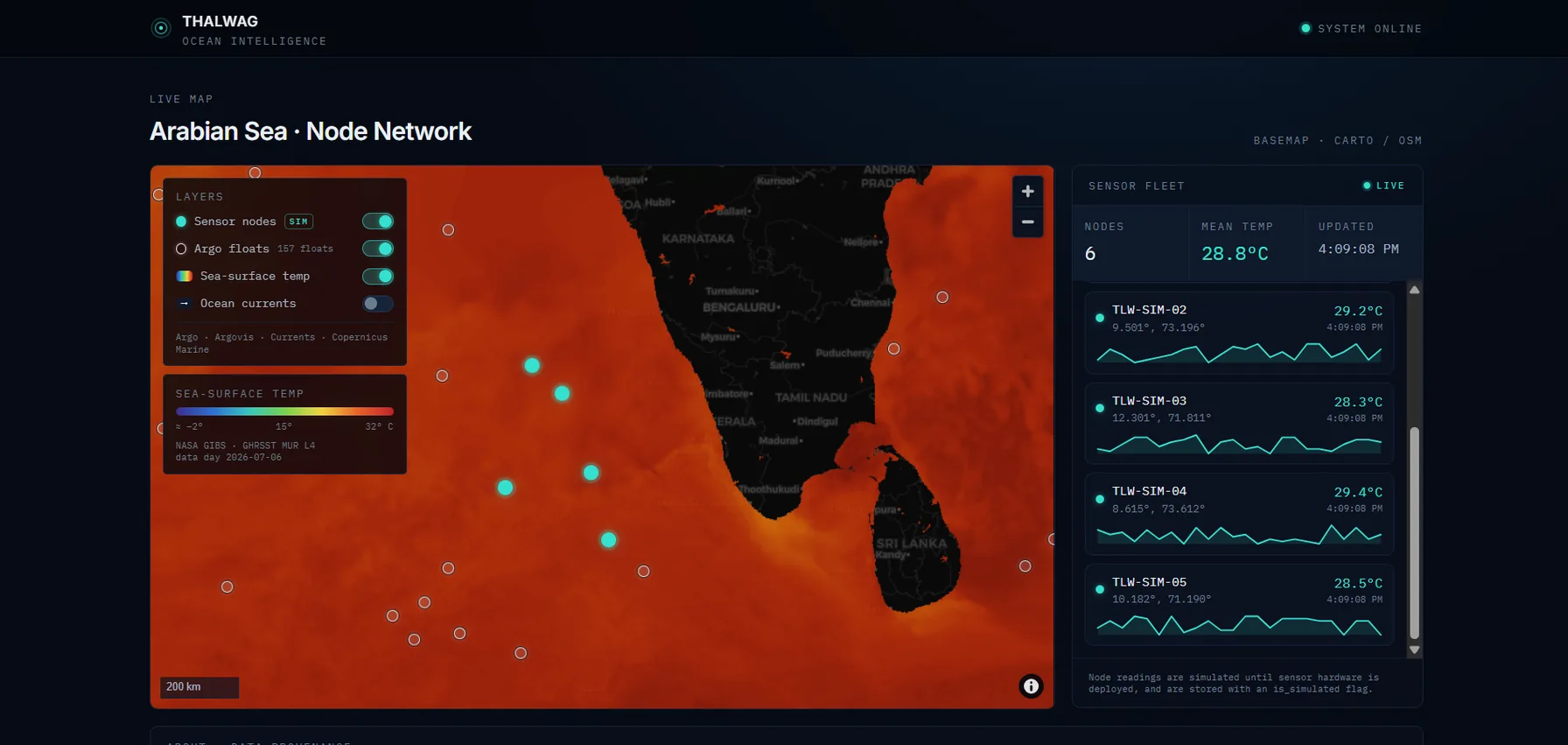
The dashboard at dashboard.thalwag.com is that model made visible - a real-time, navigable view of the sea, assembled entirely from openly licensed observation: sea-surface temperature from NASA GIBS (GHRSST MUR L4), Argo-float profiles via Argovis, and ocean currents from Copernicus Marine, over a CARTO / OpenStreetMap base. That data is live and real.
The THALWAG sensor fleet that will one day join it is still being built - no hardware is at sea yet. So the vessel nodes on the map are simulated placeholders, labelled SIM and stored with an is_simulated flag. What is measured is marked measured; what is simulated is marked simulated. Nothing on it pretends to be more than it is.
05 - THE DESTINATION
It begins with a concrete, immediate problem: a fisher who does not know whether the water ahead of him is safe. Weather forecasting uses the atmosphere above the sea; almost nothing uses the sea itself. A real-time ocean state - temperature layers, salinity fronts, current patterns - gives fishers better route decisions, earlier anomaly signals, and the knowledge that what they observe matters.
But the model does not stop at India's coast. The Arabian Sea and the Bay of Bengal are among the most climatically significant bodies of water on Earth - monsoon drivers, carbon sinks, fishery baselines. As the observation network grows, the model becomes a public resource: open data for researchers, ground truth for climate models, a reference layer for ocean-adjacent policy.
We are not building a product. We are building the institution that should have existed all along - one that understands the ocean the way we understand the atmosphere, because someone finally gave it eyes.
06 - FIND YOUR WAY IN
For Fishers
Join the network, fit a sensor, and see what your daily routes reveal. Your observations improve the same forecast you depend on.
How it works →For Researchers
All observations are published under CC BY 4.0. API access, bulk download, and model output are available without gatekeeping.
For Government
Fishery management, disaster early warning, maritime domain awareness - all require knowing what the ocean is doing right now. We can tell you.
Partner with us →For Partners
We are looking for sensor manufacturers, marine technology companies, NGOs working with fishing communities, and research institutions who want to contribute to - and benefit from - a shared ocean intelligence. The network is open. The model is open. Come in.
FOUNDER'S NOTE
I grew up in Kochi, where the Arabian Sea is a fact of daily life and fishing is a livelihood going back centuries. I am not a fisherman. I am someone who looked at how much of the ocean we do not understand, and at the 200,000 vessels that cross it every day, and thought: these two facts should fix each other.
THALWAG is not finished. It is barely begun. But the direction is clear: the people who know this sea best should be the ones helping us understand it - not as a courtesy, not as a data source to be extracted, but as partners, with credit and compensation and a voice in what gets built.
If you are a fisher, a scientist, an engineer, a policy person, or simply someone who thinks the ocean deserves better than our current collective indifference - this is an invitation.